


Photonics & Optical Sensors Research Laboratory
(PhOSLab)
Pushing the boundaries of light-matter interaction in the heart of Cyprus


LAB CORDINATOR
Kyriacos Kalli is director of the Photonics and Optics Sensors Research Laboratory (PhOSLab) at the Cyprus University of Technology (CUT), where he is a full Professor of Photonics in the Department of Electrical Engineering, Computer Engineering and Informatics and is a former department chairman. He received the B.Sc. (Hons) in Theoretical Physics and Ph.D. in Physics from the University of Kent, UK, where he studied linear and non-linear phenomena in optical fibres. He co-authored “Fiber Bragg Gratings: Fundamentals and Applications in Telecommunications and Sensing”, has many book contributions, more than 350 publications (> 10,500 citations, h-index: 47) and is the holder of 3 patents. He is a member of the IOP (C.Phys.), IEEE and a senior member of Optica. His research interests are in Bragg grating and optical fibre sensors, fibre laser development, femtosecond laser microfabrication in glass and polymers, plasmonics and quantum communications and sensing, and his CUT research funding contribution exceeds €16M. Since moving to Cyprus has established two unique research laboratories focussing on laser-based optical fibre sensor development, and terrestrial and satellite-based quantum communications and sensing.
RESEARCHERS


PHD CANDIDATES


ALUMNI


research
About Us

Leading the Light Revolution
The Photonics & Optical Sensors Research Laboratory (PhOSLab) at the Cyprus University of Technology is a research laboratory dedicated to developing advanced photonic technologies that transform light into powerful tools for sensing, communication and measurement. Our research combines optical fibre technology, femtosecond laser processing, laser–material interactions, photonic devices and advanced optical sensing. We develop novel fibre and waveguide technologies for applications ranging from biomedical and neural interfaces to structural health monitoring, smart cities, environmental monitoring and secure quantum communications.Through internationally funded research projects and collaborations with leading academic, research and industrial partners, PhOSLab bridges fundamental photonics research with real-world technological applications.
INNOVATION

Breakthroughs in femtosecond laser micromachining through the fabrication of optical fibre sensors.
COLLABORATION

A multidisciplinary team of experts integrating quantum physics, optical engineering, and material science to solve complex challenges.
EDUCATION

Training the next generation of researchers in photonic technologies.
LEADERSHIP

Defining international standards for applied optical sensors and quantum communications.
PUBLISHED WORK




| Project name | Research Initiatives | Total Budget |
|---|---|---|
| SEEWQCI | SEEWQCI (South-East European to Western European Quantum Communication Infrastructure) is a strategic project that aims to create a cross-border quantum communications network between Greece, Bulgaria, Cyprus, and the Netherlands. | €2,800,288 |
| PL-LiDAR* | Photonic Lantern-Based LiDAR systems for future climate-neutral and smart-cities | €175,000 |
| Move2treat | Mapping the brain-spinal cord interaction towards understanding and treatment of movement disorders | €2,900,000 |
| CYQCI* | Cyprus Quantum Communication Infrastructure | €7,500,000 |
| LightSense* | Intelligent light sensing for next generation smart grids | €1,054,000 |
| POSPORI* | Polymer Optical Sensors for Prolonged Overseeing the Robustness of civil Infrastructures | €158,000 |
| LUMIOS | Fluoride monolithic mid-infrared optical laser sources (LUMiOS) | €160,000 |
| T-Sense* | Fiber-Optic Sensors for real-time measurements of radiation dose and hypoxic tumor assessment | €250,000 |
| ACORes | Advanced concrete optical remote sensors | €87,000 |
| IRC-HERMES* | Interregional cultural heritage management e-system | €1,025,000 |
*Host Organisation/ Cordinator


Advanced Fibre & Photonic Component Fabrication
At PhOSLab, we use high-precision femtosecond laser inscription and advanced fibre processing to transform optical fibres into custom-designed photonic devices. Our approach enables the fabrication of structures with precisely controlled spectral, spatial and modal characteristics, from conventional Fibre Bragg Gratings to complex, application-specific photonic architectures. Rather than being limited to commercially available components, we develop and fabricate the optical structure your experiment or system actually requires.
| Fibre Bragg Gratings | Advanced Fibre Structures |
|---|---|
| Standard FBGs | Fibre interferometers |
| Tilted FBGs | Fabry–Pérot and in-fibre cavities |
| Apodized FBGs | Long-period gratings |
| Chirped FBGs | Mode-selective structures |
| Phase-shifted FBGs | Diffraction gratings |
| Superstructured FBGs | Higher-order gratings |
| Multiplexed FBG arrays | Fibre-tip structures |
| High-reflectivity gratings | Custom refractive-index modifications |
| Custom spectral profiles |
We can control the position, geometry, strength and spatial distribution of laser-induced modifications along and across the fibre, enabling tailored grating envelopes, apodisation profiles and complex photonic structures. Your demonstrated arbitrary spatial apodisation work is particularly useful evidence here: the reported technique allows customizable grating profiles and demonstrated >30 dB side-lobe suppression.
Specialty Fibre & Fibre-Optic Sensing
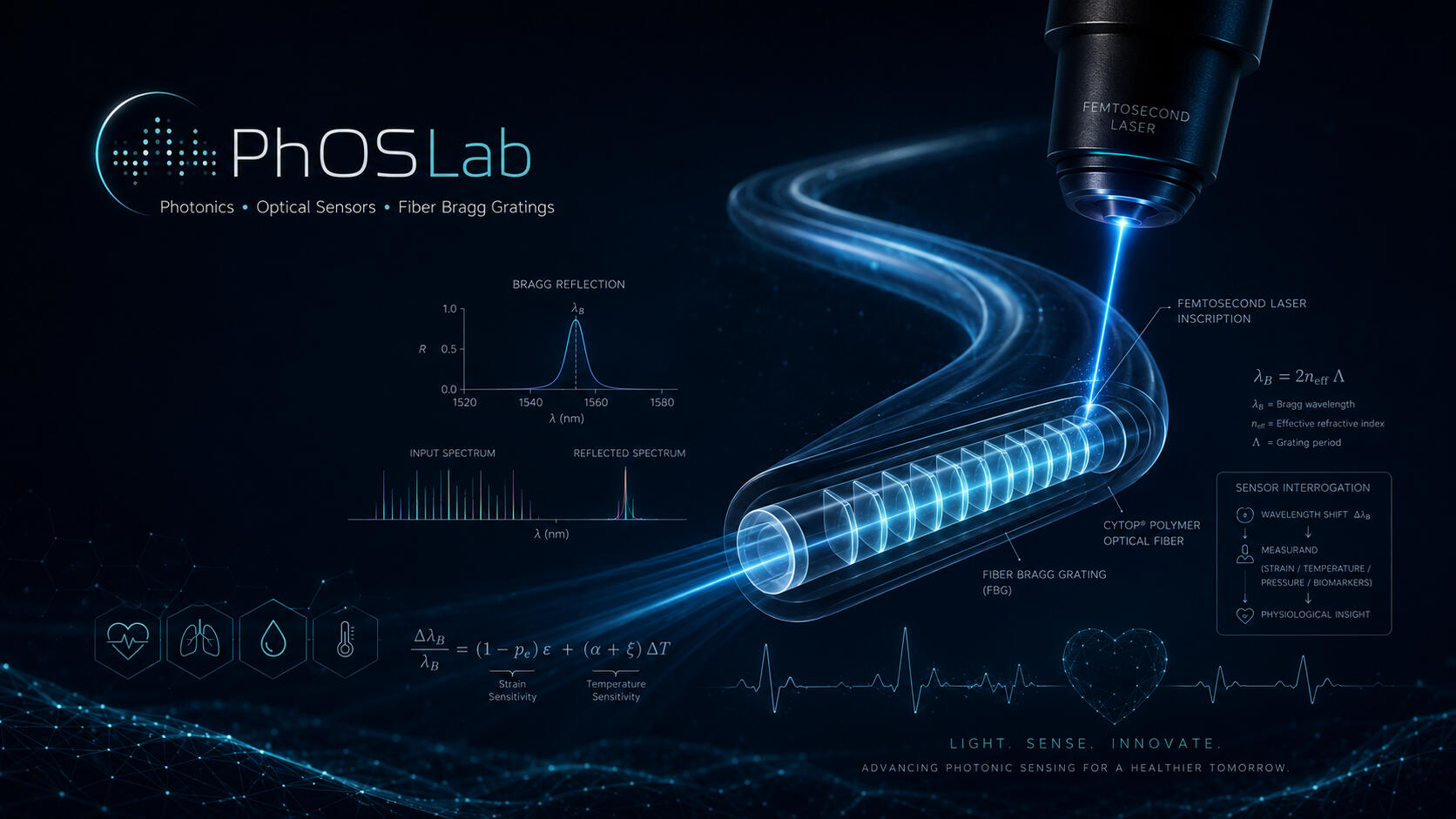
We develop inscription and sensing technologies across a broad range of specialty fibre platforms, including polymer, sapphire, fluoride, multicore and other unconventional fibres, enabling photonic devices for environments and applications where conventional silica fibres are not sufficient.
Polymer Optical Fibres: Flexible. Lightweight. Biocompatible. Large-core. Application-specific.We investigate femtosecond-laser inscription of photonic structures in polymer fibres including low-loss perfluorinated polymers and other specialty polymer platforms. Potential applications include:- Biomedical sensing
- Temperature and humidity monitoring
- Force and strain sensing
- Bend and shape sensing
- Structural monitoring
- Flexible and wearable photonics
- Fibre-optic neural interfaces
Fluoride & Mid-IR Fibres: Photonic components for wavelengths beyond conventional telecom photonics.We develop femtosecond-laser-inscribed structures in fluoride fibres for mid-infrared operation, including FBGs and fibre-laser components. Applications include:-Mid-IR fibre lasers
-Chemical and environmental sensing
-Spectroscopy
-Non-silica photonic systemso
Laboratory Equipment and Facilities
Quantum Communications
PhOSLab develops and tests quantum communication technologies in laboratory and fibre-network settings and is preparing for satellite-to-ground links. Our work centres on quantum key distribution (QKD), which uses quantum signals to establish cryptographic keys, and on integrating those keys into the systems that protect real-world communications.
CYQCI: Cyprus's national quantum network

The Cyprus Quantum Communication Infrastructure (CYQCI) project, led by Prof. Kyriacos Kalli, is coordinated by the Cyprus University of Technology. PhOSLab has led the project's technical work, from network design and QKD system evaluation to deployment and performance testing. Together with national partners, the team deployed Cyprus's first QKD network, connecting seven government organisations over existing telecommunications fibre.Our CYQCI research also includes evaluating commercial QKD equipment, developing a pilot QKD system, and studying optical switching and the coexistence of quantum and classical signals in the same fibre. Beyond the network itself, CYQCI supports research and technical training, and lays the terrestrial foundation for Cyprus's participation in the European Quantum Communication Infrastructure (EuroQCI).
SEEWQCI: connecting Cyprus to Europe

PhOSLab leads the Cypriot contribution to the South-East Europe to Western Europe Quantum Communication Infrastructure (SEEWQCI) project. Building on CYQCI, this work will connect Cyprus's terrestrial QKD network to European partners via satellite, overcoming the distance limits of fibre-only QKD.A central activity is preparing the Cypriot optical ground station for QKD with EAGLE-1, Europe's first space-based QKD system, and linking the station to the national fibre network. With our partners, we will investigate how key material can be managed and relayed between satellite and terrestrial networks, and how different key management systems can interoperate. The resulting infrastructure will support cross-border demonstrations involving Cyprus, Greece, Bulgaria and the Netherlands.Together, CYQCI and SEEWQCI advance Cyprus's role in developing quantum-secure communications across Europe.
Quantum Sensing
Coming Soon...